
If you’ve been exploring offshore hiring, there’s a good chance you’ve heard a lot about talent quality, cost efficiency, and cultural compatibility. But there’s one factor that often goes overlooked, time zone alignment. And when it comes to real-time collaboration with U.S.-based teams, Latin America is in a league of its own.
Research from Harvard Business School shows that even a one-hour time-zone difference significantly reduces real-time communication and collaboration, making nearshore alignment a meaningful productivity advantage for distributed teams. That's why, at WeHireFast, we focus on matching our clients with the best Latin American talent.
Nearshore hiring in Latin America has become a true game changer for U.S. companies looking to scale efficiently. The combination of real-time collaboration, cultural alignment, geographic proximity, and cost advantages makes the region one of the most compelling destinations for remote talent today.
Businesses are increasingly turning to Latin America not only for technical roles like software development and IT, but also for operations, customer service, sales, marketing, executive assistance, and finance. The region’s talent pool is vast, diverse, and highly skilled, providing companies with the flexibility to build strong remote teams across almost any department.
According to ADP Research Institute’s global workforce survey, Latin America has the highest share of workers confident in their skills and lower reported burnout than North America.
Latin America’s strong professional infrastructure, rising tech education programs, and growing startup scene have created an ecosystem where talent thrives. With time zone compatibility ensuring that teams can collaborate naturally, companies experience higher productivity, faster execution, and smoother workflows.
Unlike traditional offshore markets (India, the Philippines, Eastern Europe), Latin America sits just one to three hours away from most U.S. time zones. This means you get the benefits of global hiring without the drawbacks of extreme time differences.
Here’s a breakdown of Latin American time zones and how they align with U.S. companies:
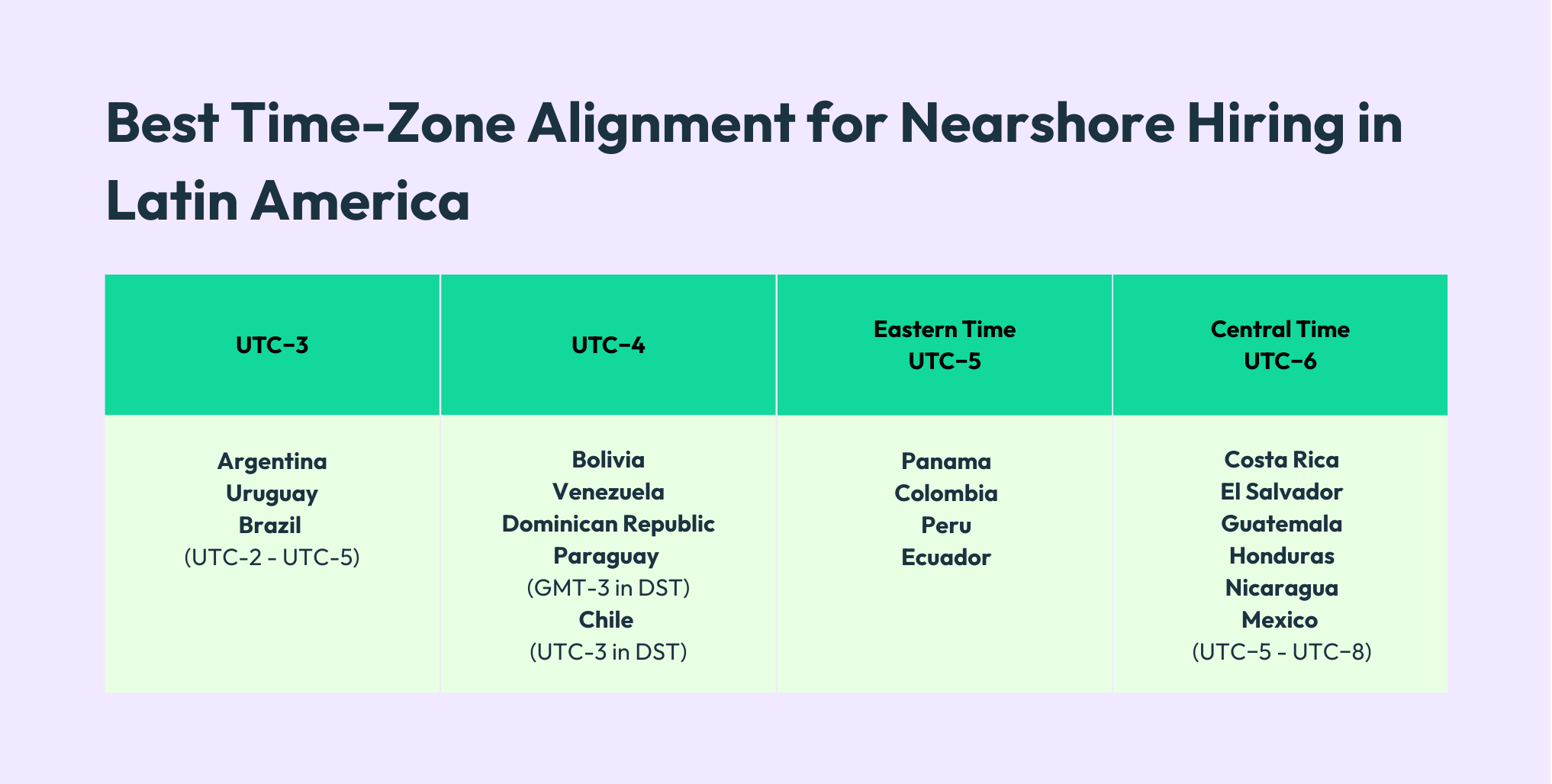
If you're hiring specifically for maximum alignment, the top picks are:
A natural fit for U.S. Central Time and great for companies based in Texas, Chicago, or the Midwest.
These countries share the same time zone as Eastern Time most of the year. This is as aligned as it gets without hiring domestically.
Ideal for EST and CST teams, especially those needing extended morning coverage.
Perfect for U.S. Eastern Time companies. A small difference of 1–2 hours makes collaboration smooth and meetings easy to schedule.
This time zone works excellent for teams wanting a slightly earlier start or extended evening coverage.
Latin America’s DST policies vary, but the impact on U.S. companies is minimal. In most cases, the shift is just one hour, far easier to manage than the double-digit hour gaps seen with Asia or Eastern Europe.
In fact, most LATAM countries do not observe daylight savings at all, keeping schedules consistent year-round.
When you’re hiring globally, the biggest friction is communication.
Distributed teams across Europe, Africa, or Asia can require late-night meetings, async-only operations, or delayed turnarounds. That’s fine for some roles, but for teams that thrive on fast execution, like operations, sales support, customer success, engineering, or executive assistance, real-time collaboration becomes essential.
Time zone alignment improves:
When your team stretches across 10 or 12 hours of difference, even simple decisions can take days. Questions get answered overnight, tasks get delayed, and communication becomes a constant juggling act.
That gap narrows dramatically with Latin America. With overlapping work hours, teams can communicate instantly, not 12 hours later. Design, engineering, finance, operations, everyone is online together.
Project timelines cut dramatically because tasks can move forward continuously with minimal bottlenecks. No more waiting until the next morning for answers or deliverables. Issues can be resolved within minutes.
According to Remote’s 2025 Global Workforce Report, companies hiring internationally cite communication speed and coordination, not talent quality, as their biggest operational risk, underscoring the importance of overlapping working hours.
Meetings become easier to schedule. Natural overlap makes team syncs and standups effortless. No one is joining at midnight or 6 am. Everyone is alert, engaged, and aligned.
Academic research on hybrid meetings finds no significant difference in engagement between remote and in-person participants when meetings are held during shared working hours and designed for active participation.
Onboarding and Training: Shared business hours also mean smoother onboarding and training. Workflows are easier to explain when your team is actually awake at the same time. Work sessions feel more natural, questions get answered immediately, and new hires integrate into the workflow far more quickly. Teams using LATAM staff often cut training time in half.
Team members develop stronger relationships because they collaborate during shared business hours, so they have more spontaneous communication and stronger team cohesion.
Nearshore talent works normal daytime hours, not the disruptive night shifts required in some offshore markets.
Research on distributed work shows that large time-zone gaps often push collaboration into early mornings or late nights, increasing burnout and reducing long-term sustainability for remote teams.
This is exactly why U.S. companies, from startups to Fortune 500, are rapidly shifting offshore hiring to Latin America.
Latin America is home to a diverse talent pool that includes software developers, designers, data analysts, operations specialists, customer service representatives, and executives.
Cities like Mexico City, São Paulo, Buenos Aires, Bogotá, and Santiago have become international hubs for tech and remote work, attracting highly skilled professionals who are well-versed in global collaboration.
Cultural compatibility is another significant benefit. Many Latin American countries have communication styles, business values, and work ethics that align closely with American corporate culture. This reduces friction, accelerates trust-building, and helps distributed teams function more cohesively.
English proficiency is widespread, especially among professionals in tech, creative industries, and customer-facing roles, which further enhances productivity and collaboration.
EF’s 2025 English Proficiency Index places several Latin American countries in the global mid-to-high tiers for English proficiency, particularly in major urban centers and professional roles.
Companies can access top-tier talent at significantly lower costs compared to US-based hires, while still maintaining high quality and strong professional standards.
Unlike more distant offshore markets, Latin America offers these cost advantages without sacrificing real-time collaboration.
Consider:
If your team works 9 am–5 pm EST, hiring in UTC-5 ensures complete overlap.
Do you want full alignment, extended coverage, or partial overlap? That will guide you to the right region.
Time zone alignment plus cultural compatibility makes LATAM a strong fit for most U.S. companies.
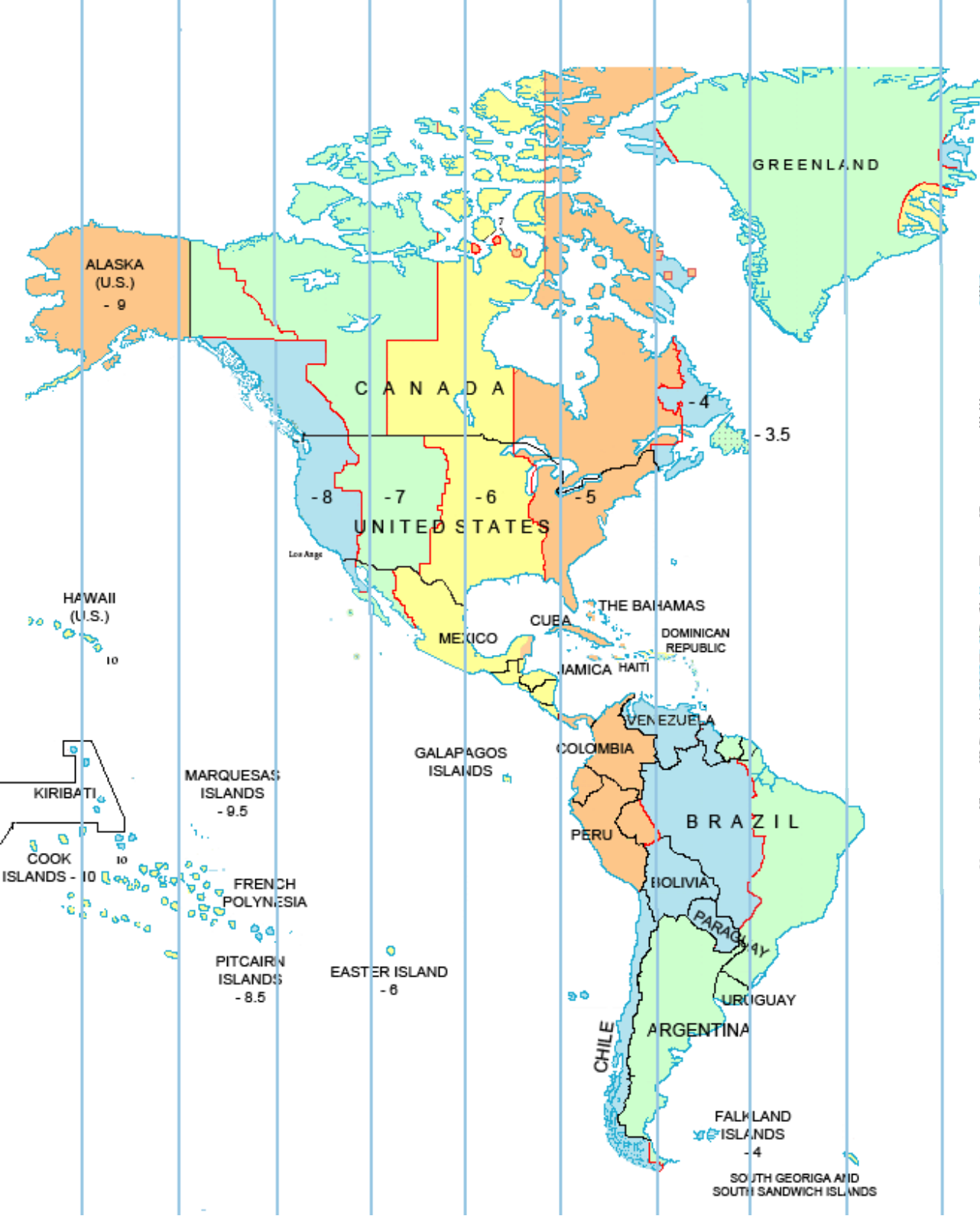
As U.S. companies continue to embrace remote and hybrid teams, Latin America stands out as a powerful ally in global expansion. The region’s time zone alignment eliminates many of the barriers traditionally associated with offshore hiring.
Latin America offers the closest, smoothest, and most productive alignment with U.S. working hours anywhere in the world.
Whether you're hiring for support roles, technical positions, operations, or executive assistance, LATAM talent gives you:
When combined with cost savings, cultural affinity, and a deep pool of skilled professionals, Latin America becomes a strategic powerhouse for nearshore hiring.
Companies that understand and leverage this alignment will be better positioned to build high-performing remote teams, accelerate growth, and stay competitive in an increasingly globalized market.


